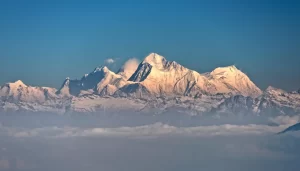
The mighty mountains of the world that lie in Himalayan and Karakoram mountain range and called 14 eight-thousanders compiled here. Yet, isn’t there another list of special peaks tempting adventurers into scaling heights? Actually, there is. The Seven Summits, the highest mountains by continent.
The Seven Summits
7 – Puncak Jaya ( 4,884 m / 16,024 ft. ) – Oceania
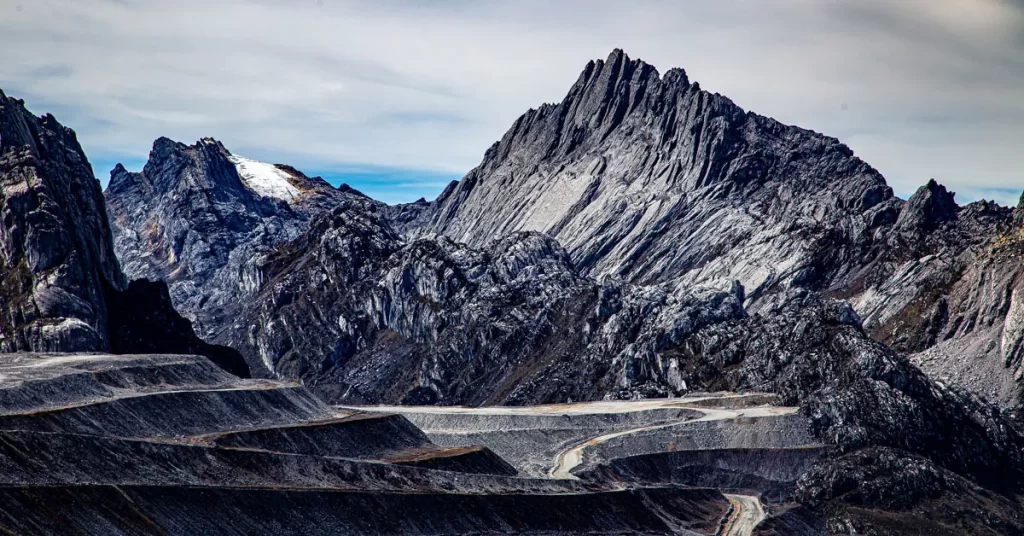
Located in the Papau province of Indonesia, Puncak Jaya is the tallest mountain in the southwestern Pacific representing Oceania. It has also an European name ‘Carstensz Pyramid’, as a result of a Dutch explorer’s sailing journey in 1623. Jon Carstensz stated he saw a mountain with glaciers in the tropics that was hard to believe by then.
The lowest elevation among other ‘the Seven Summits’ misleads. The route up the north face presenting all hard rock surface requires technical climbing. The first successful summit expedition was in 1962 by Austrian mountaineer Heinrich Harrer. If the name sounds familiar, check here out to see whom we are talking about.
6 – Mount Vinson ( 4,892 m / 16,050 ft. ) – Antarctica

The highest point of Antarctica, a continent that is completely covered in ice. Named in honor of U.S. Congressman Carl Vinson who was a supporter of the Antarctic researches, Mount Vinson is the prominent height in the Sentinel Range of Ellsworth Mountains. An American aviator, Lincoln Ellsworth, spotted her in 1935 and mountaineer Nicholas Clinch and his team were able to visit the peak in 1967. The average temperature (between -30°C and -90°C) and remoteness of the South Pole explain why less than two thousand attempts made over the last fifty years even though the mountain itself is not challenging.
5 – Mount Elbrus ( 5,642 m / 18,510 ft. ) – Europe

As an inactive volcano comprised of twin cones, Mount Elbrus (Russia) stands in the western part of the Caucasus Mountains that straddles Asia and Europe. The eastern peak is 173 ft. shorter than the western peak and conquered 65 years earlier as well (in 1829). The last eruption was around 50 A.D., however, several hot springs on the flanks and sulfurous gasses emitting from eastern slopes of the mountain show the signs of activity.
To beat Mt. Elbrus is easy. There is a cable car serving to ascend up to 12,500 feet. From there, the majority who have little alpine experience in general take the Standard Route through the south side. Additionally, many rode a horse and a Russian team led by Alexander Abramov drove an SUV to reach the top.
4 – Kilimanjaro ( 5,895 m / 19,341 ft. ) – Africa

An ecological mixture of rainforest, alpine desert, arctic summit and more. Made up of three volcanic cones (Mawenzi, Shira, and Kibo which is the highest one and is likely to erupt again), Kilimanjaro is the world’s tallest free standing mountain and rises in a national park encompassing 775.75 square kilometers in the northeastern corner of Tanzania.
Since 1889, when a German geologist Hans Meyer teamed up with an Austrian climber Ludwig Purtscheller, and a local guide Yohani Kinyala Lauwo to set foot on Africa’s apex, Kilimanjaro has left more than 80 percent of snow caps and become a popular walkable mountain for everyone. Annually, over 25,000 people make a push to get to the top of Kibo to record something in a book stored there.
3 – Denali ( 6,194 m / 20,310 ft. ) – North America

Previously known as Mount McKinley, Alaskan Denali is the third of the Seven Summits. In fact, if measured from the base to the summit, Denali (18,000 ft.) surpasses Everest (15,000 ft.) by 3,000 feet. Looming above the swift currents melted from the glaciers all around the mountain, it dominates the horizon and can be seen from the cities Anchorage and Fairbanks, both of which are at least a hundred miles away. Not surprising that ‘Deenaalee’ means ‘The Great One’ in native language of Koyukon Athabaskans.
Residing so close to the Arctic Circle, Denali poses some cold-related threats. Avalanches, frigid weather, and fast moving storms cause only half of those who plan to go on an excursion to the top of North America to accomplish what they set to do. Nearly five hundred climbers each year. That thrilling success started being achieved in 1913, by Hudson Stuck, Harry Karstens, Robert Tatum, and Walter Harper.
2 – Mount Aconcagua ( 6,961 m / 22,837 ft. ) – South America

Outside Asia, that is home to the first 188 tallest mountains on earth, Aconcagua is a gigantic mass of rock taking the lead in the Western and Southern Hemispheres. About 15 kilometers off the border between Chile and Argentina, it extends skyward in the Principle Cordillera. A mountain range in the Andes dividing the Atlantic and the Pacific watersheds continentally.
In 1987, a Swiss climber and guide Matthias Zurbrigen didn’t fail unlike others who tried several times from 1883 to 1897 to see the summit before anyone else. Today, via ‘Normal Route’, along the Northwest Ridge which is 20% shorter than the ‘Polish Traverse Route’, trekking up the mountain is possible. Nevertheless, extreme altitude and high winds generally force to retreat.
1 – Mount Everest ( 8,848 m / 29,028 ft. ) – Asia

Everest. The king of the Seven Summits, the king of mountains. Towering over anything else in or out of sight, it is the roof of the world. Above sea level, there is no other mountain to claim the title (from its underwater base, Hawaii’s Mauna Kea is 1,118 meters higher than Mt. Everest). Nepal on the south and Tibet, an autonomous region in East Asia, on the north, other names appeared naturally too. Tibetans call it as ‘Qomolangma’ or ‘Chomolungma’ (Holy Mother of the Earth) and Nepalese as ‘Sagarmatha’ (God of the Sky).
Although George Mallory and Andrew Irwine are debated as to whether they managed to go up to the summit in 1924, Edmund Hillary and Tenzing Norgay did that in 1953 indisputably. Thereafter, Everest turned to be the most famous mountain having traffic jams sometimes. The base camp of it attracts approximately 35,000 tourists every year.